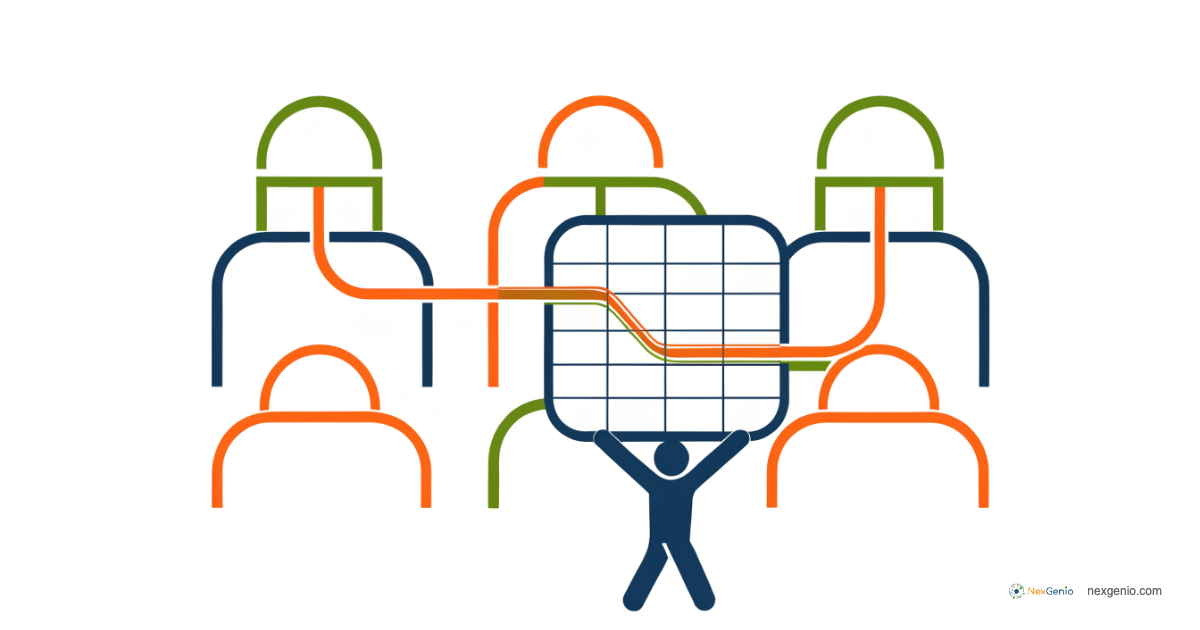
A compliance manager opens her laptop on Monday morning. She has fourteen tabs open. One for the NIS2 gap analysis. One for the DORA register of ICT third-party providers. One for the ISO 27001 Statement of Applicability. One for the AI risk assessment the board requested last quarter. One for the spreadsheet that tries to tie it all together.
That spreadsheet is the actual governance architecture. Everything depends on it. And it lives on one person's machine.
This is more common than any executive wants to admit.
Here is what the situation looks like in practice:
- Five regulatory and standards frameworks, each with its own control set, its own evidence requirements, its own audit cycle.
- Controls that overlap across frameworks but are documented separately, creating duplicate work and conflicting records.
- Evidence collected three or four times for the same underlying process, stored in different folders, described in different language.
- A single point of failure: one person who understands how the pieces connect, carrying the mapping in her head and her spreadsheet.
- Every new regulation added to the pile multiplies the workload instead of fitting into an existing structure.
Most organisations diagnose this as a resourcing problem. They hire another analyst, buy another GRC tool, add another tab to the spreadsheet. The backlog shrinks for a month, then grows again.
The real problem is architectural. These frameworks were never designed to be managed in isolation. NIS2 and DORA share incident reporting obligations. ISO 27001 and ISO 42001 share risk methodology and management system structure. The EU AI Act introduces requirements that sit on top of information security controls already mapped elsewhere. When each framework gets its own silo, the organisation does the same work repeatedly and still has gaps between the silos where obligations fall through.
The fix is a single governance architecture that treats all frameworks as parallel views of the same operational reality. Shared controls get mapped once. Evidence gets collected once and tagged to every framework it satisfies. Audit preparation draws from one source of truth, filtered by framework, instead of five separate binders assembled under pressure.
NexGenio builds exactly this. A unified compliance architecture where NIS2, DORA, ISO 27001, ISO 42001, and the EU AI Act sit inside one coherent structure. Obligations are cross-mapped at the control level. Evidence pipelines feed every framework simultaneously. The spreadsheet becomes unnecessary because the architecture itself holds the logic.
This requires people who understand each framework deeply enough to see where they converge. That cross-framework competence is the foundation: professionals trained as NIS2 Lead Implementer, DORA Lead Manager, ISO 27001 Lead Implementer, and ISO 42001 Lead Implementer, with the operational AI literacy a Certified AI Manager brings to the table. That combination is what turns five separate compliance projects into one governed system.
One structure. One evidence base. All frameworks. No spreadsheet required.